

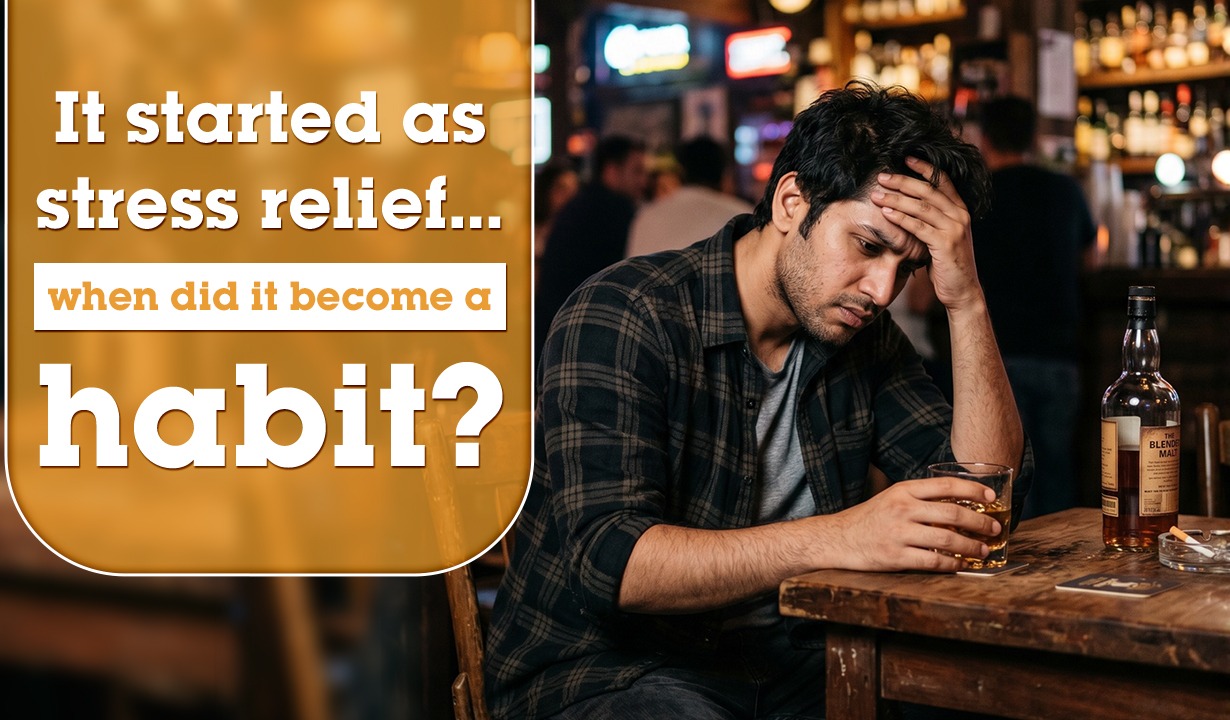
It started with one drink to unwind.
After a hard day.
A bad meeting.
A week that wouldn't end.
One drink became two.
Two became a habit.
The habit became the thing you look forward to most.
And somewhere along the way, the line between "I enjoy this" and "I need this" quietly moved.
Most people never notice when it moves — this is often how habits quietly turn into hidden dependencies.
That's the thing about alcohol dependence from daily drinking.
It doesn't announce itself.
It just becomes normal.
India's After-Work Drinking Reality
This is not a fringe behaviour.
16 crore people in India between the ages of 10 and 75 are current alcohol users.
Among them, approximately 26% are already dependent.
That is a significant portion of people who began drinking socially and arrived somewhere they did not intend to be.
The after work drinking every day culture is increasingly normalised in Indian urban professional spaces in a way that makes it particularly difficult to examine honestly.
It is social.
It is expected.
It is, for many people, the only decompression ritual available after a demanding day.
Which is exactly why signs of alcohol dependence are so easy to miss.
Stress Drinking vs Alcohol Addiction: Where Is the Line?
Not everyone who drinks after work every day is dependent.
But the progression from stress drinking vs alcohol addiction follows a recognisable path.
Here is what that path looks like:
Stage 1: Social and Situational Drinking
Drinking in specific contexts.
Celebrations. Social events. Occasionally after a hard day.
Control is present. Absence creates no distress.
Stage 2: Regular Stress-Relief Drinking
Drinking becomes a deliberate stress management tool — understanding how stress and addiction are deeply connected makes this shift easier to recognise.
After-work drinking every day starts here.
It works. That's the problem.
Alcohol does reduce cortisol in the short term.
The brain notices. It begins to associate alcohol with relief.
Neural pathways start forming.
Stage 3: Habitual Drinking
The drink is no longer a choice. It is a routine.
Skipping it creates mild irritability or restlessness.
The amount needed for the same effect begins to increase.
This is tolerance building.
Neurologically, the brain has adapted to the presence of alcohol and reduced its own natural stress-regulation mechanisms accordingly.
Stage 4: Dependence
Absence of alcohol creates genuine discomfort.
Not just preference.
Physical or psychological distress.
Anxiety on days without drinking.
Difficulty sleeping without it.
Reaching for alcohol not to feel good.
But to feel normal.
This is alcohol dependence from daily drinking.
And it is far more common than functional alcoholism signs suggest on the surface.
💡 Not sure where you are on this spectrum? Prarambh Life's anonymous assessment is a private, judgment-free first step. No labels. No one needs to know.
The Signs Most People Rationalise Away
The daily drinking risks are not always obvious to the person drinking.
Because the brain that is developing dependence is also the brain doing the assessment.
Watch for these signs of alcohol dependence:
- You think about the drink before the workday ends
- Skipping a day creates irritability or anxiety you attribute to other causes
- You've quietly increased the amount without deciding to
- You feel more yourself after a drink than before it
- You've started drinking alone more than socially
- You find reasons why today is a valid exception to any attempt at a break
- You've had moments of wondering whether your drinking is a problem and dismissed them quickly
That last one is particularly important.
The question "am I dependent on alcohol" is not one people ask casually.
If it has arrived, it deserves an honest answer.
Why "I'm Functioning Fine" Is Not a Safe Measure
Functional alcoholism signs are defined by their invisibility.
You are meeting your deadlines.
Maintaining your relationships on the surface.
Fulfilling your responsibilities.
Functioning alcoholism is real.
And it is one of the most dangerous forms of alcohol dependence from daily drinking because it removes the external consequence that might otherwise drive someone toward help.
The internal cost, however, is accumulating.
Sleep quality deteriorating even if sleep quantity is maintained.
Cognitive sharpness reducing gradually in ways that are only visible in retrospect.
Emotional regulation becoming increasingly alcohol-dependent.
Physical health effects building slowly.
Liver, cardiovascular system, brain structure — all affected by daily alcohol consumption at a pace that doesn't produce immediate symptoms.
The absence of visible crisis is not the absence of a problem.
It is a problem that hasn't yet become visible.
What the Brain Is Actually Doing
When you drink every day, the brain does what it always does.
It adapts.
It reduces its own GABA activity because alcohol is producing it externally.
It increases glutamate activity to compensate for alcohol's sedative effects.
It downregulates dopamine production because alcohol is providing artificial reward.
The result is a brain that requires alcohol to maintain what it previously maintained naturally.
Remove the alcohol and the brain is suddenly operating without the mechanisms it depended on.
This is withdrawal.
And depending on the level of dependence, it can range from uncomfortable to medically serious.
This is why stopping daily drinking without support can be dangerous.
And why the question of how much alcohol is too much is not just about units.
It is about what your brain has done with those units over time and the daily drinking risks involved.
When Does Drinking Become Alcoholism?
There is no single moment.
There is a gradual accumulation of neurological adaptation until the point where the brain cannot regulate itself normally without the substance.
The clinical distinction between alcohol use disorder and casual drinking is not about quantity alone.
It is about:
- Loss of control over consumption
- Continued use despite consequences
- Tolerance development
- Withdrawal symptoms in absence
- Increasing priority given to alcohol over other activities
If three or more of these are present, alcohol dependence is clinically indicated.
Not as a judgment.
As a medical reality.
One that responds to structured intervention far better than to willpower alone.
The Honest Conversation Worth Having
Only 1 in 38 people with alcohol dependence in India gets any treatment.
Not because dependence is rare.
Because the conversation is hard to start.
Because the label feels like a verdict.
Because the path to help seems to require public acknowledgment of a problem that the person has been managing privately.
It doesn't have to.
The first step is not a declaration.
It is simply an honest look at where the drinking has arrived.
And whether the place it has arrived is where you intended to be.
Take Prarambh Life's anonymous assessment. No judgment. No labels. Just clarity.
Frequently Asked Questions (FAQs)
- Is drinking after work every day a sign of alcohol dependence?
Not necessarily. However, after work drinking every day can gradually lead to alcohol dependence from daily drinking. - What is the difference between stress drinking and alcohol addiction?
The difference lies in control. Stress drinking starts as a coping mechanism, while addiction develops when alcohol becomes necessary. - What are the early signs of alcohol dependence?
Thinking about drinking, irritability without alcohol, increasing quantity, and drinking alone are common signs. - What are the risks of drinking alcohol daily?
Reduced sleep quality, increased tolerance, emotional dependence, and long-term health effects. - Can someone be dependent on alcohol and still function normally?
Yes. This is known as functional alcoholism, where signs are not immediately visible.
Prarambh Life is India's structured digital recovery programme for addiction. Available on web and app.


