

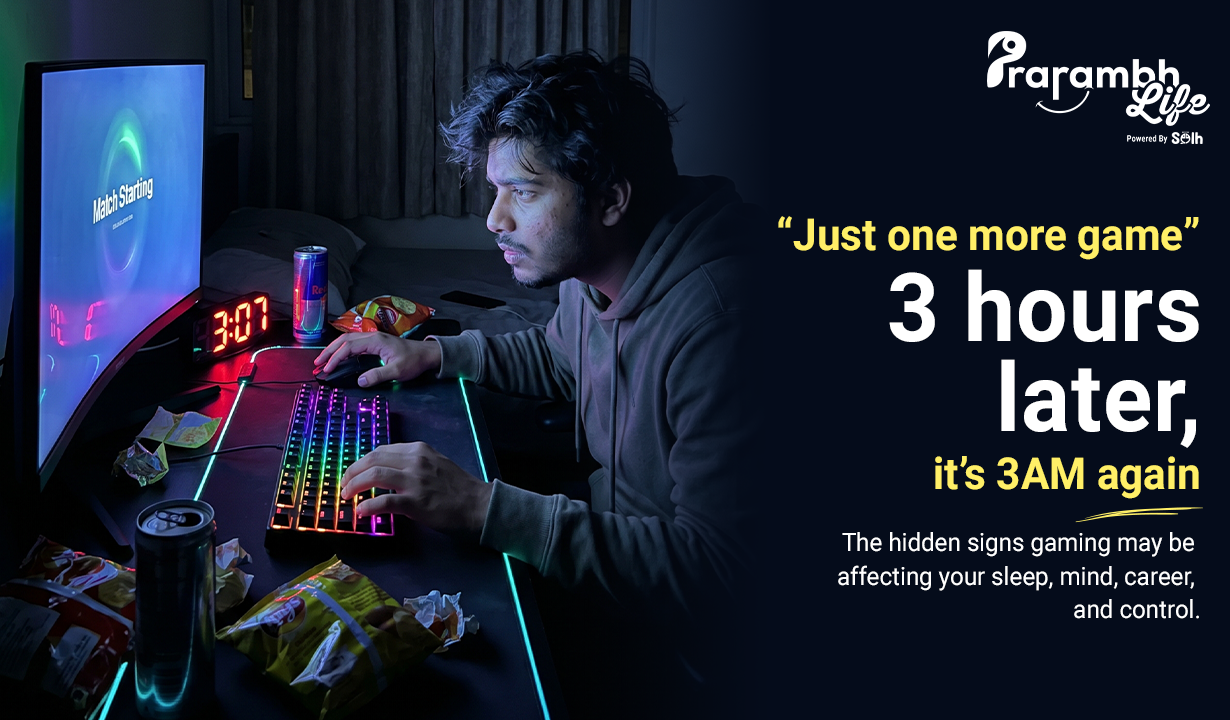
It started as something you enjoyed.
A way to unwind.
Connect with friends.
Escape for an hour after a long day.
Then the hour became three. Three became until 2am. Meals started getting skipped. Sleep became something that happened when the game allowed it. And somewhere in that progression, the question shifted from "do I want to play?" to "why can't I stop?"
Gaming addiction doesn't arrive all at once. It creeps. And it is particularly hard to identify because, unlike alcohol or substances, gaming is legal, accessible, socially accepted, and in many circles actively celebrated. That is what makes it so easy to miss.
India's Gaming Reality
India has over 400 million gamers. 70% of them are under the age of 24. The Economic Survey 2026 flagged digital addiction including gaming as a growing national concern, noting that Indians collectively spent 1.1 lakh crore hours on smartphones in 2024.
Gaming is not a niche behaviour in India. It is a mass phenomenon. And within that mass phenomenon, a significant and growing number of people have crossed the line from recreational use into gaming disorder, the clinical term for gaming addiction recognised by the World Health Organisation since 2018.
When Gaming Stops Being Fun
The shift from enjoyment to addiction happens gradually. But there are recognisable signs of gaming addiction that precede the crisis point.
1. Loss of control over time
You sit down to play for an hour. You look up and four hours have passed. You intended to stop at midnight. It is 3am. The inability to stop when you intended to is one of the earliest and clearest signs of gaming addiction.
2. Withdrawal when not playing
When you cannot play, not just boredom, but genuine restlessness, irritability, anxiety, or preoccupation with when you will be able to play again. The game has become the primary regulation tool for your nervous system.
3. Neglect of basic needs
Meals delayed or skipped. Sleep sacrificed consistently. Personal hygiene deprioritised. Social obligations cancelled. When the game consistently wins against basic self-care, the threshold into addiction has been crossed.
4. Impact on real-life functioning
Late to work or college because of gaming. Performance dropping. Relationships strained or damaged. In the most severe cases, employment lost. Video game addiction symptoms at this stage are no longer hidden. But often by this point, denial is deeply entrenched.
5. Continued use despite consequences
The most definitive marker. You know it is causing problems. You play anyway. Not because the pleasure outweighs the cost in any rational calculation. But because the compulsion has become stronger than the awareness.
💡 Gaming addiction is a recognised disorder with a structured recovery path. Prarambh Life's behavioural addiction programme starts anonymously, on your phone.
Why "It's Just a Hobby" Keeps People Stuck
Gaming addiction carries a specific form of denial. Because gaming is not socially stigmatised the way substance use is. Because being good at games is in many communities a source of status. Because the consequences, at least initially, feel reversible.
The internal conversation often sounds like:
"I'm not hurting anyone."
"I could stop if I wanted to."
"It's just a way to relax."
"Real addiction is drugs and alcohol."
Each of these is a way of creating distance between the behaviour and the word addiction. But gaming disorder has the same neurological architecture as substance dependence. The same dopamine dysregulation. The same tolerance building. The same withdrawal. The same progressive loss of control.
The substance is digital. The mechanism is identical.
What Is Happening in the Brain
Gaming activates the brain's dopamine reward system with extraordinary efficiency. Variable rewards, the unpredictable nature of in-game outcomes, are neurologically identical to the mechanism that makes gambling addictive. Achievement systems, level progression, rankings, create dopamine spikes that the brain begins to crave. Social connection within games provides genuine belonging rewards that further reinforce the behaviour.
Over time, with excessive gaming, the brain adapts. Dopamine receptor sensitivity reduces. Real life, which provides rewards more slowly and less predictably, starts to feel dull by comparison. The impact of gaming on mental health becomes measurable. Motivation for non-gaming activities decreases. Anxiety in offline situations increases. The game becomes not a source of pleasure but a requirement for normal functioning.
How Much Gaming Is Too Much?
There is no universal answer to how much gaming is too much. The WHO's diagnostic criteria for gaming disorder focus not on hours but on:
- Whether gaming has priority over other life interests and activities
- Whether the behaviour continues or escalates despite negative consequences
- Whether there is significant impairment in personal, family, social, educational, or occupational functioning
- Whether this pattern persists for at least 12 months
Hours matter less than impact. The question is not "how many hours do I play?" The question is "what is gaming costing me, and am I making that choice consciously?"
The Shame That Keeps Gamers From Asking for Help
Gaming addiction in India sits in an uncomfortable space. Too normalised to be taken seriously by family. Too stigmatised to be admitted openly. Too invisible compared to substance use to access the same support pathways.
Many people with gaming disorder spend years in cycles of cutting back, relapsing, feeling ashamed, and cutting back again. Without ever accessing structured support. Because the support pathways that exist were designed for substances. Not for behavioural addiction.
This is the gap Prarambh Life was built to address.
Recovery From Gaming Addiction Is Real
Gaming disorder responds to the same principles that govern all addiction recovery. Trigger mapping. Craving management. Structured alternative behaviour. Gradual re-engagement with real-life reward systems. Support that doesn't require explaining the problem to people who won't understand it.
The goal is not to never play again. For most people, the goal is control. The ability to choose when to play and when to stop. Without the compulsion making that decision instead.
Prarambh Life's behavioural addiction programme. Start anonymously, on your phone, at your own pace.
Prarambh Life is India's structured digital recovery programme for addiction. Available on web and app.
FAQs
1. What are the early signs of gaming addiction?
Some of the earliest signs of gaming addiction include losing track of time while playing, neglecting sleep or meals, irritability when unable to play, and difficulty stopping even when you want to.
2. Is gaming disorder officially recognised?
Yes. Gaming disorder has been officially recognised by the World Health Organisation (WHO) since 2018 as a behavioural addiction condition.
3. How does gaming addiction affect mental health?
Excessive gaming can increase anxiety, reduce motivation for offline activities, disrupt sleep, and negatively impact emotional regulation and relationships over time.
4. Can gaming addiction be treated without quitting gaming completely?
Yes. For many people, recovery focuses on rebuilding control over gaming habits rather than eliminating gaming entirely. Structured support and behaviour management strategies can help.
5. How does Prarambh Life help with gaming addiction recovery?
Prarambh Life offers a structured digital recovery programme designed for behavioural addictions like gaming disorder. The programme helps users understand triggers, manage compulsive patterns, and gradually rebuild healthier routines with anonymous and accessible support.


