

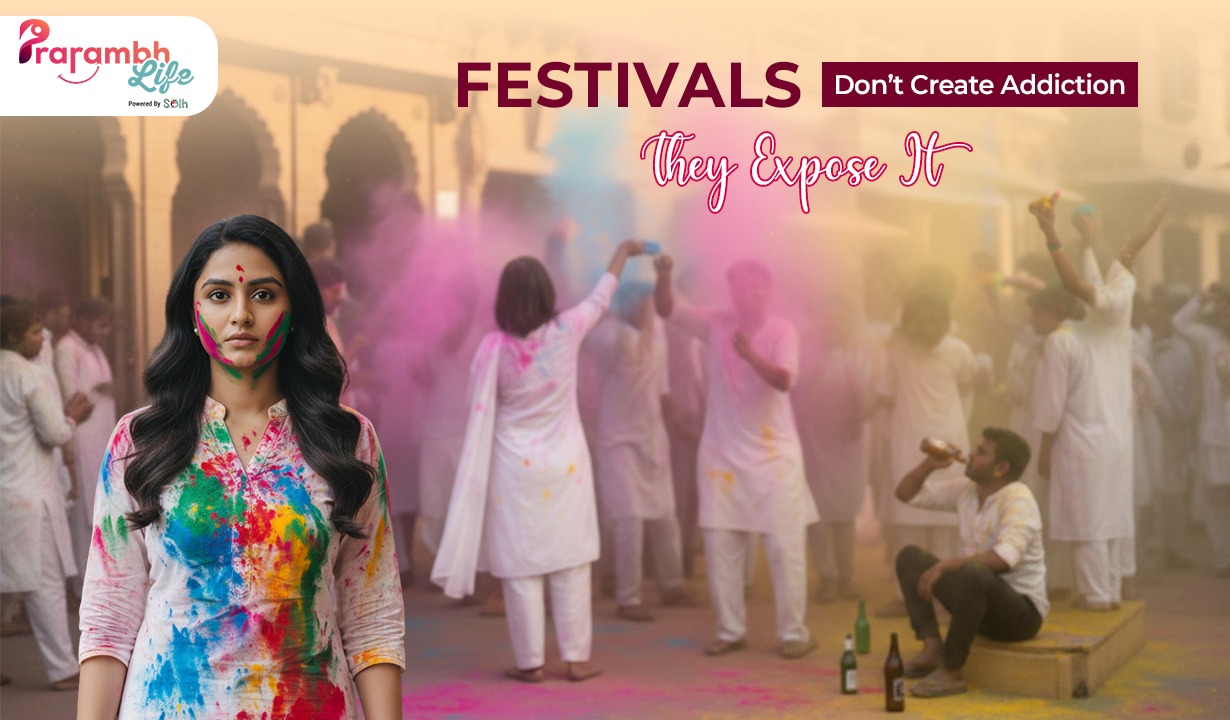
Holi, Dopamine & Escapism: Why We Celebrate Harder Than We Heal
Every year, Holi arrives with colour, chaos, music, laughter - and something else we don't talk about enough.
Dopamine.
For many people, Holi isn't just about celebration.
It's about release. Escape. Numbing. Overdoing.
And sometimes… festival relapse.
If you've ever told yourself:
- "It's just one day."
- "Everyone drinks on Holi."
- "I deserve to let loose."
- "I'll get back on track after this."
This blog is for you.
Because Holi is not the problem.
But what it activates in the brain - especially in the context of Holi relapse triggers - that's where the real story begins.
Why Does Holi Trigger Addictive Behaviour?
Holi creates the perfect psychological storm for addictive patterns and festival relapse triggers.
Let's break it down clearly.
1. Social Permission
During Holi, behaviours that may normally feel "excessive" become socially acceptable.
- Drinking in the morning? Normal.
- Binge eating? Expected.
- Overusing substances? "Bura na mano, Holi hai."
When society temporarily removes restraint, the brain interprets it as permission.
For someone already struggling, this becomes one of the strongest emotional triggers during celebrations.
2. Dopamine Overload
Addiction is not about substances alone.
It's about dopamine - the brain's reward chemical and how dopamine during festivals behaves differently.
Holi offers:
- Loud music
- Sugar-heavy food
- Alcohol
- Social validation
- Physical stimulation
- Sensory overload
Each of these spikes dopamine.
When combined, they create a dopamine surge that mimics addictive highs.
If someone is in recovery, this sudden spike can reactivate old neural pathways and increase the risk of holiday relapse patterns.
3. Emotional Vulnerability
Festivals amplify emotions.
For some people, Holi means:
- Family pressure
- Relationship triggers
- Loneliness
- Comparison
- Social anxiety
Relapse often returns not because of celebration - but because of emotional discomfort underneath it.
The substance becomes the coping mechanism, especially when coping strategies during festivals are missing.
Does Holi Cause Relapse?
Short answer: Holi doesn't cause relapse.
Triggers + vulnerability + lack of preparation do.
Relapse is rarely a single decision.
It's a chain reaction that often defines festival relapse more than the event itself.
Let's understand how that works.
How Relapse Actually Happens During Festivals
Most people think relapse looks like this:
"I decided to drink again."
In reality, it looks like this:
- Emotional trigger builds quietly.
- Stress increases.
- Exposure to substance happens.
- Rationalization begins.
- The brain recalls old dopamine memories.
- Impulse control weakens.
- Behaviour happens.
The brain remembers the reward long before it remembers the regret.
This is neuroscience - not weakness - and it explains many cases of relapse prevention during festivals failing without structure.
Why "Just One Day" Is Risky in Recovery
The phrase "Just today" is common during Holi.
But here's what happens neurologically:
- The brain's reward circuit reactivates.
- Dormant pathways light up.
- Craving intensity increases in following days.
- Guilt creates shame.
- Shame increases vulnerability.
- Cycle restarts.
This is why many people experience a dopamine crash after celebration and then spiral weeks later.
It wasn't about Holi.
It was about reopening the reward loop.
What About People Who Aren't in Recovery?
You may not identify as "addicted."
You might say:
- "I don't drink daily."
- "I only smoke socially."
- "I binge only on weekends."
- "I scroll late at night sometimes."
Holi often reveals patterns we ignore.
Ask yourself honestly:
- Do I need a substance to feel relaxed socially?
- Do I struggle to stop once I start?
- Do I justify excess as celebration?
- Do I feel uneasy without stimulation?
If yes, it may not be addiction yet - but it may be a dependence pattern forming.
And dependence grows quietly, especially around repeated holiday relapse patterns.
Why Festivals Increase Dopamine Sensitivity
After a high-stimulation day like Holi, many people report:
- Low mood next day
- Irritability
- Anxiety
- Cravings
- Fatigue
This is called a dopamine crash.
When dopamine spikes too high, the brain compensates by reducing baseline levels temporarily.
This creates discomfort.
The brain then seeks the quickest way to restore dopamine - often through the same behaviour.
That's how "one day" becomes "one more weekend," reinforcing the cycle of festival relapse.
How To Enjoy Holi Without Triggering Relapse
Recovery doesn't mean isolation.
It means awareness + structure.
Here are practical ways to stay regulated and support staying sober during festivals:
1. Decide Before You Arrive
Don't negotiate with yourself at the party.
Make your decision in advance:
- "I won't drink."
- "I'll leave by 4 PM."
- "I'll attend for 2 hours only."
Clarity protects you from impulse.
2. Eat & Hydrate Properly
Low blood sugar increases impulsivity.
Dehydration increases emotional volatility.
Simple physical care reduces relapse risk significantly.
3. Have An Exit Plan
Always know:
- Who you can call
- How you will leave
- Where you will go after
Uncertainty increases vulnerability and weakens relapse prevention during festivals.
4. Replace, Don't Just Remove
If you remove alcohol, replace it with:
- Mocktails
- Soda + lime
- Something in your hand
The brain often seeks ritual, not just substance.
5. Leave Before Overstimulation Peaks
Notice your threshold.
When noise + energy + stimulation feels overwhelming, that's your signal.
Don't wait until willpower drops.
What If You Already Relapsed This Holi?
First: pause.
Relapse is not moral failure.
It's neurological vulnerability.
Second: do not spiral.
The biggest damage doesn't come from the relapse.
It comes from:
- Shame
- "I've ruined everything"
- "I'm back to zero"
- "I might as well continue"
That thinking is the real trigger.
Instead, ask:
- What was I feeling before it happened?
- What did I tell myself?
- What environment was I in?
- What support was missing?
Relapse is data.
And data helps you build a stronger plan.
Why Unstructured Recovery Fails During Festivals
Many people try to quit alone.
Without:
- Trigger mapping
- Emotional awareness
- Dopamine education
- Daily structure
- Check-ins
When a festival hits, the system collapses.
Because willpower alone cannot fight environment + neurochemistry.
Recovery requires structure.
Not just intention.
Exploring effective treatment options can help break the cycle before festival relapse patterns repeat.
How Prarambh Life Approaches Festival Triggers Differently
Prarambh Life is designed for real-world triggers - including festival relapse scenarios.
Not isolated rehab environments.
Inside the program:
- You identify your personal triggers.
- You understand your addiction type (low, moderate, high risk).
- You learn how dopamine works in your brain.
- You build coping replacements.
- You create a structured plan.
- You track urges.
- You learn relapse recovery protocols.
It is online.
Private.
Self-paced.
But structured.
Because addiction does not pause for festivals.
And neither should your support system.
Is It Addiction Or Just Celebration?
Here's a simple self-check:
If celebration:
- You can stop easily.
- You don't think about it later.
- You don't crave it next week.
- You don't hide it.
If dependence:
- You anticipate it intensely.
- You struggle to stop.
- You feel low after.
- You justify excess.
- You feel slightly guilty.
Honest awareness is the first step.
Why We Celebrate Harder Than We Heal
This may be the most important question.
Why do we go all-in during celebration…
But hesitate when it comes to healing?
Because healing requires:
- Slowness
- Reflection
- Discomfort
- Structure
- Accountability
Celebration offers:
- Noise
- Escape
- Excitement
- External validation
- Temporary relief
The brain chooses the easier dopamine.
Until the crash becomes unbearable.
Holi Can Be A Reset Too
Holi symbolises burning the old.
Let this Holi burn:
- Denial
- "Just one day" thinking
- Hidden patterns
- Shame
- Isolation
Colour doesn't need intoxication.
Connection doesn't need substances.
Joy doesn't need numbing.
And if you feel like you need help navigating this - that's strength, not weakness.
Final Thought
If Holi is triggering for you this year, don't ignore that signal.
It's not about being dramatic.
It's about being aware.
Addiction doesn't start loudly.
It starts socially.
It starts seasonally.
It starts "occasionally."
And by the time we call it addiction, the pattern is deeply wired.
You don't need rehab to start healing.
You need structure.
Understanding.
And a plan.
If you're ready to move from celebration highs to emotional stability -
Prarambh Life is built for that transition.
Because recovery isn't about avoiding life.
It's about participating in it - without losing yourself.
FAQs
1. Why does Holi increase the risk of festival relapse?
Holi combines social permission, emotional triggers, and dopamine overload, which can reactivate old reward pathways. This makes festival relapse more likely without preparation and structure.
2. Does celebrating during Holi always lead to relapse?
No, Holi itself doesn't cause relapse. Triggers, vulnerability, and lack of coping strategies during festivals are what increase the risk.
3. What is a dopamine crash after festivals?
After intense stimulation, dopamine levels temporarily drop below baseline, leading to low mood, irritability, and cravings. This crash often fuels post-festival relapse patterns.
4. How can I prevent relapse during Holi celebrations?
Decide boundaries in advance, eat and hydrate properly, have an exit plan, and replace substances with alternatives. Structured relapse prevention during festivals reduces impulsive decisions.
5. How does Prarambh Life help manage festival relapse triggers?
Prarambh Life provides structured support, trigger mapping, dopamine education, and relapse recovery protocols tailored for real-world celebrations. It helps you prepare before festivals instead of reacting after setbacks.


