

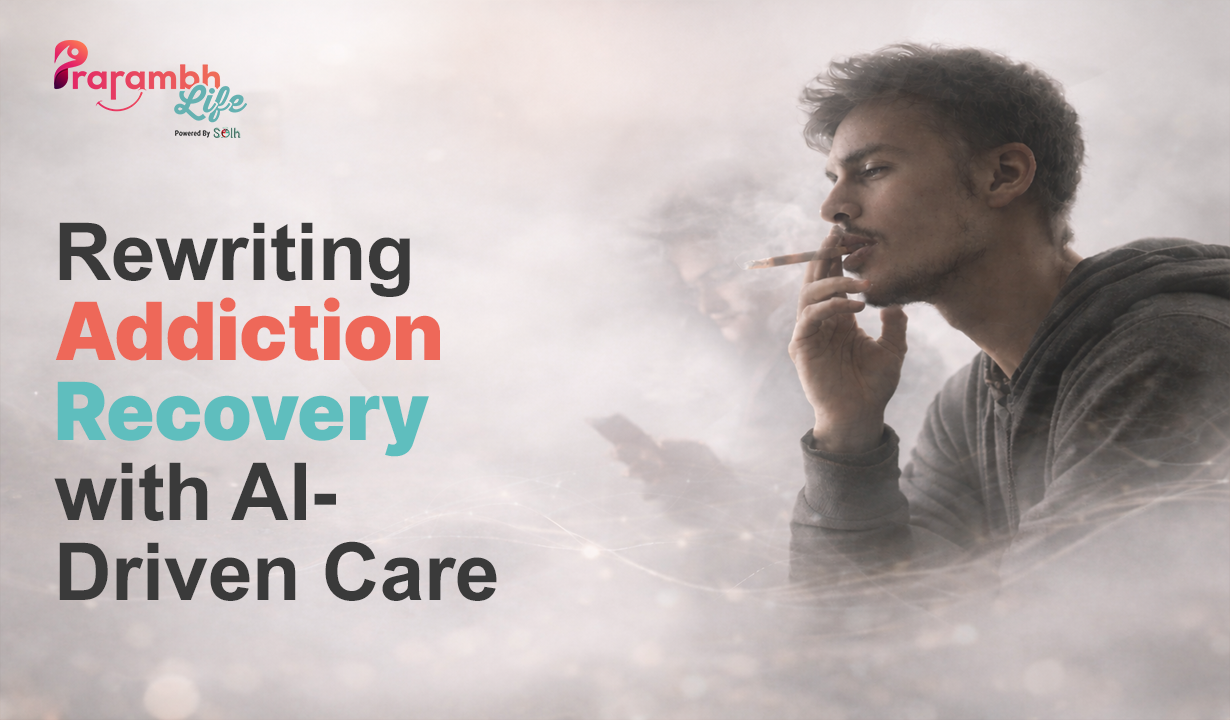
An online de-addiction program powered by AI is redefining addiction recovery. By combining behavioral science, stress biometrics, AI-driven insights, and human guidance, modern digital recovery programs help individuals address both behavioral and substance addictions—confidentially, proactively, and sustainably.
Why Traditional Addiction Recovery Models Are Falling Short
Addiction today doesn’t always look extreme.
People are functioning—working, studying, socialising—yet struggling with:
- Phone addiction
- Internet and social media addiction
- Gaming addiction
- Alcohol dependency
Traditional rehab models often fail because they are:
- Location-bound
- Time-intensive
- Stigma-heavy
- Reactive instead of preventive
This is why online addiction recovery and digital de-addiction programs are becoming the preferred path, especially in India.
What Is an Online De-Addiction Program (Really)?
An online de-addiction program is not just therapy on a screen.
It is a structured, technology-enabled recovery system designed to work within real life.
It focuses on:
- Understanding behavior patterns
- Regulating stress and cravings
- Preventing relapse
- Supporting long-term recovery
This shift—from isolation to integration—is where technology plays a decisive role.
Where AI Actually Fits in Addiction Recovery (No Buzzwords)
AI in addiction recovery is not about replacing humans.
It’s about seeing patterns humans can’t track continuously.
To learn more about how innovative technology enhances digital de-addiction support, see our detailed breakdown of how technology is revolutionizing the Prarambh Life de-addiction program.
At Prarambh Life, AI is used in three clear, ethical ways.
1️⃣ Streffie: AI-Based Stress Biomarker
One of the strongest predictors of relapse is unregulated stress.
Streffie is an AI-powered stress assessment tool that:
- Uses facial analysis to detect stress biomarkers
- Identifies stress spikes before cravings escalate
- Tracks patterns over time, not one-off moments
This makes Streffie a preventive AI layer, not a diagnostic label.
In recovery, this matters because:
Addiction doesn’t begin with craving.
It begins with unmanaged stress.
This is AI-based addiction recovery focused on early intervention.
2️⃣ SOLH Buddy: The AI Companion for Everyday Regulation
Recovery doesn’t fail in therapy sessions.
It fails between sessions, during everyday life.
SOLH Buddy is an AI companion designed to:
- Check in during emotionally vulnerable moments
- Help users pause, reflect, and regulate stress
- Offer grounding support without judgment
- Encourage consistency during the recovery journey
This is not a chatbot giving advice.
It is AI-powered addiction recovery support focused on emotional regulation and continuity.
Which Addictions Benefit Most from AI-Based Recovery?
AI-enabled programs are particularly effective for:
🔹 Behavioral Addictions
- Phone addiction
- Internet addiction
- Social media addiction
- Gaming addiction
These fall under behavioral addiction types, driven by dopamine loops and stress responses.
🔹 Substance-Related Addictions
- Alcohol addiction
AI supports:
- Trigger awareness
- Stress-craving linkage
- Relapse prevention strategies
This makes substance abuse treatment more adaptive and humane.
Recovery Is a Process, Not a Detox Event
Quick detox programs address symptoms, not systems.
Effective recovery follows the stages of addiction recovery:
- Awareness
- Stabilisation
- Behavior correction
- Relapse prevention
- Long-term maintenance
AI allows recovery programs to adapt across these stages, rather than resetting after each slip.
Recovery & Solution: Prarambh Life’s AI-Enabled De-Addiction Model
Prarambh Life is a confidential, online de-addiction program in India, designed for both behavioral and substance addictions.
It integrates:
- Streffie for AI-based stress detection
- SOLH Buddy for daily AI-supported regulation
- Expert-led recovery guidance
- Peer and family support
- Structured relapse prevention
Recovery happens without leaving life, not by escaping it.
3-Month Digital Rehab Program (AI-Supported)
Ideal for:
- Early-stage addiction
- First-time recovery seekers
- Behavioral addiction patterns
- Post-detox stabilisation
What this program focuses on:
- AI-guided habit and stress pattern awareness
- Personalized recovery roadmap
- Streffie-based stress insights
- SOLH Buddy-led daily regulation
- Early relapse prevention strategies
🎯 Outcome:
Stability, awareness, and control before addiction deepens.
6-Month Digital Rehab Program (AI-Driven Deep Recovery)
Ideal for:
- Long-term addiction
- Multiple relapse history
- Alcohol addiction or severe behavioral dependency
What this program focuses on:
- Long-term pattern recognition using AI
- Nervous system regulation
- Virtual recovery coaching
- Advanced relapse prevention
- Sustainable lifestyle restructuring
🎯 Outcome:
Durable recovery that holds under real-world stress.
Why AI-Enabled Online Recovery Works Better
AI-supported recovery works because it is:
- Continuous, not episodic
- Preventive, not punitive
- Personalised, not generic
- Confidential, not stigmatizing
This is why AI-powered digital rehab platforms are becoming the new standard globally.
FAQ Section
Q1. What makes an online de-addiction program effective?
Structure, stress regulation, relapse prevention, and continuous support.
Q2. How does AI help in addiction recovery?
By identifying stress patterns, predicting relapse risk, and supporting daily regulation.
Q3. Is AI replacing therapists in recovery?
No. AI supports insight and continuity; humans lead care.
Q4. Can recovery happen without physical rehab?
Yes. Online, structured programs are highly effective.
Final Insight
Addiction recovery is no longer about isolation.
It’s about intelligent support within real life.
AI doesn’t replace care.
It makes care timely, precise, and sustainable.
That’s why AI-enabled de-addiction is not a trend—
it’s the future of recovery.


